New insights into the regulators that control cell shape
First systematic functional characterisation and systems view of Rho GTPases, the key regulators of cell shape changes
Summary
- For the first time, researchers show how RhoGAP and RhoGEF proteins work collectively in space and time to change a cell’s shape
- New research explores the over 140 such human proteins and how they interact to change cell shape
- Cell shape changes are the basis of many fundamental biological processes, from cell division to cell migration. When these changes go wrong, they can cause serious health issues.
23 March, Cambridge – The cells in our bodies are constantly dividing, migrating and changing their shape. For decades, researchers have known that these changes take place within the cytoskeleton, a network of fibrous proteins that exists within each cell. Rho GTPases are like molecular switches that act as the central regulators of the cytoskeleton. RhoGTPases themselves are controlled by 145 RhoGEF and RhoGAP proteins.
Despite several RhoGEF and RhoGAP proteins being previously well-described, many were largely uncharacterised, and it was still unclear how they interact with each other in space and time to make cell shape changes happen. Researchers at EMBL’s European Bioinformatics Institute (EMBL-EBI) and the Max Delbrück Centre for Molecular Medicine (MDC) in Berlin, together with other collaborators from the Lunenfeld-Tanenbaum Research Institute (LTRI) in Toronto, and elsewhere, have now published in Nature Cell Biology the first systematic study of RhoGEF and RhoGAP proteins, showing where they act within the system of the cell and what they interact with.
“This is the first time we have been able to look at these proteins collectively, rather than individually, and it has offered some very interesting and unexpected insights,” says Evangelia Petsalaki, Research Group Leader at EMBL-EBI. “This is also an excellent resource for other scientists who want to find out more about their favourite cell shape regulator.”
Why do cells change shape?
Cell shape changes are the basis of many fundamental biological processes, from cell division to cell migration, and from building organs during embryonic development to immune cell surveillance. When a cell can’t control its shape changes, hundreds of diseases can occur, including cancer and developmental disorders.
A systems approach
“To understand cell shape changes, we must first understand the concept of localisation, which refers to where in the cell something is happening, when and for how long,” explains corresponding author Oliver Rocks from the MDC. “For example, for a cell to move, the front has to be protruding and the back has to be retracting. This requires different combinations of GTPases to act at specific times in different parts of the cell, otherwise the cell isn’t going anywhere.”
Proteins control what GTPases do, when and where, almost like a smart home assistant can switch on or off the lights in a house. RhoGEFs turn GTPases on and RhoGAPs turn them off. So the precise balance of certain RhoGEFs and RhoGAPs allows highly localised control of cell shape. Until now, this balance has not been well understood, but is explored in some detail in the current study. This includes an analysis of where 141 out of 145 RhoGEFs and RhoGAPs act in the system of the cell, what they interact with, their localisation and specificity.
The researchers found, among other things, that cell shape change processes are not just controlled by a single RhoGEF or RhoGAP at a time, but many different ones working together to control different aspects of cytoskeleton rearrangement. They also discovered how this collective behaviour of the regulatory proteins contributes to generating RhoGTPase signal gradients, not just uniformly distributed activities. The mechanisms by which cells establish such local zones of protein activity and prevent signals from leaking to unwanted cell areas were previously not well understood.
Focal adhesions
For a cell to move in a certain direction, it requires a sequence of two antagonistic processes: protrusion at the front of the cell and contraction at the cell body. These two aspects of cytoskeleton rearrangement are controlled by two prominent GTPases – RAC1 and RHOA. When RAC1 levels are high and RHOA levels are low, protrusion happens at the front of the cell. On the other hand, when RHOA levels are high, and RAC1 levels are low, contraction happens at the cell body. So how are these key signalling zones controlled?
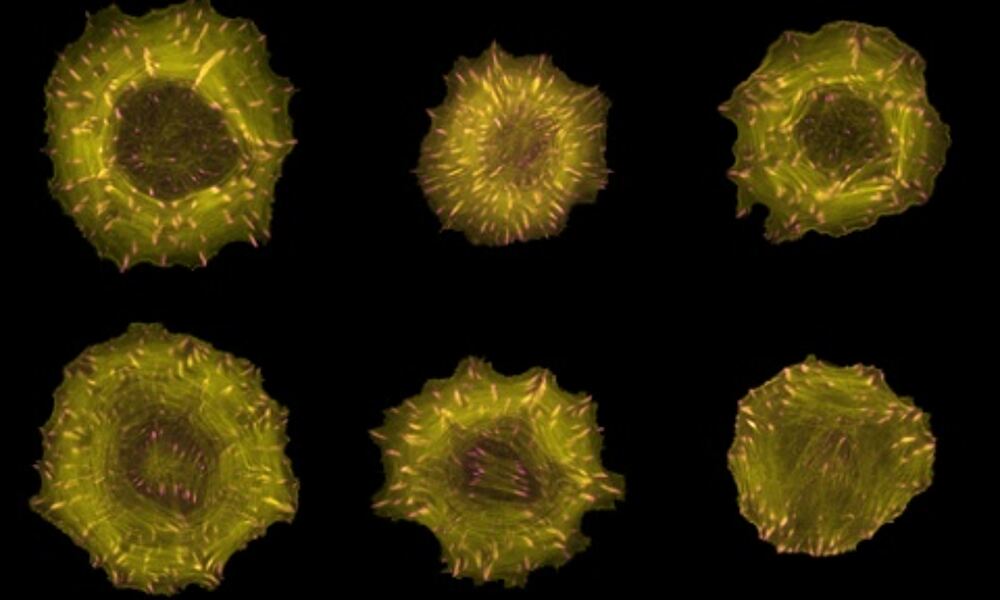
Focal adhesions are structures by which cells attach to their environment. To the researchers’ surprise, they found that focal adhesions serve as platforms that can host different types of regulators of cell shape. As they form, mature and disassemble in a cycle, they move from the cell periphery to the centre. The research found that newly forming focal adhesions and mature focal adhesions are located in different places in the cell and assemble different kinds of regulators. This process spatially segregates them to create signalling zones that control cell migration.
“The paper also opens up a range of new research avenues,” concludes Petsalaki. “It’s like a one-stop shop for researchers interested in finding out more about Rho signalling and their regulator of choice.”
Source articles
Muller, P.M., et al. (2020). Systems-analysis of RhoGEF/RhoGAP regulatory proteins reveals spatially organized RAC1 signalling from integrin adhesions. Nature Cell Biology. Published online 23 March; DOI: 10.1038/s41556-020-0488-x
Funding
This work was supported by funding from the European Molecular Biology Laboratory (EMBL), the Human Frontier Science Program (LT000759/2008-L) and Helmholtz Young Investigator Program VH-NG-737 (to O.R.), the CIHR Post-doctoral fellowship award (to R.D.B.), the Cancer Research UK (CRUK) Programme Foundation Award (C37275/A20146) and the Stand Up to Cancer campaign for Cancer Research UK (to C.B.), Genome Canada through Ontario Genomics, the Ontario Government (ORF GL2-025) and the Terry Fox Research Institute (to T.P.).