New AlphaFold Database entry pages
The AlphaFold Database entry pages have been redesigned with a cleaner layout, improved navigation, and a more intuitive experience for exploring predicted protein structures across devices
The AlphaFold Protein Structure Database (AFDB) has redesigned its entry pages to make exploring predicted protein structures faster, clearer, and more intuitive. This update delivers a streamlined experience across devices, whether you’re browsing from the lab, your desktop, or on the move.
The redesign is part of EMBL-EBI’s broader effort to improve access to structural biology data for a wide range of users, from students and clinicians to machine learning specialists and structural biologists.
Developed in collaboration with Google DeepMind, the AlphaFold Database serves over 200 million protein structure predictions, and the updated interface ensures that this vast resource remains easy to explore and interpret.
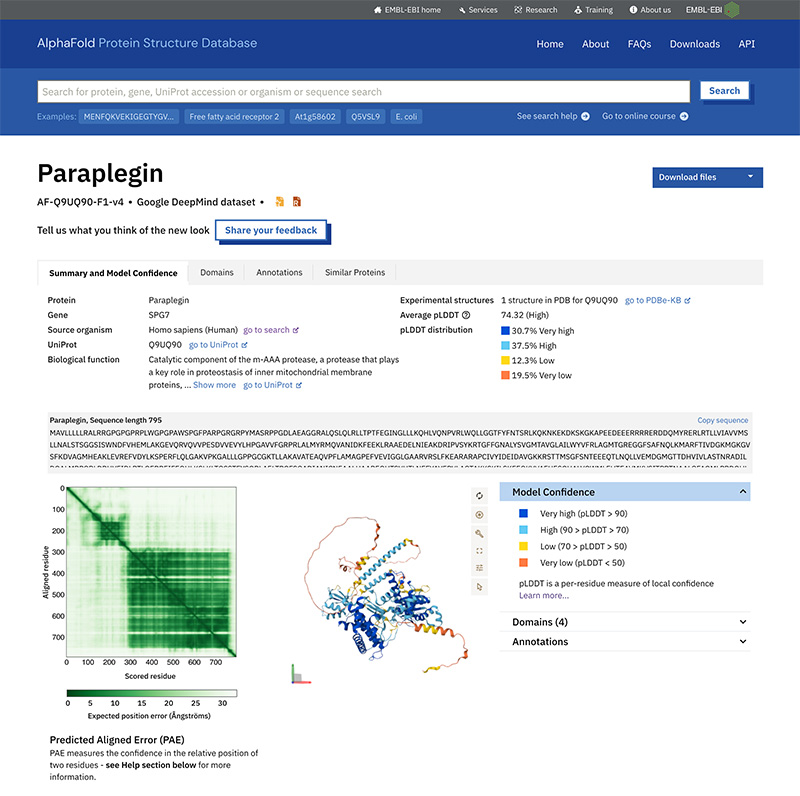
New entry page highlights:
- Simplified Mol* 3D viewer with clearer confidence mapping
- Faster page load times and improved mobile responsiveness
- Redesigned layout for better navigation and visual clarity
- Clean, collapsible annotation panels that emphasise structure-function relationships
- Visual consistency with the new PDBe Entry Pages and other EMBL-EBI tools
These updates are designed to support rapid exploration and cross-referencing of predicted structure data, helping researchers focus on insight and discovery.
 “AlphaFold predictions have transformed how researchers explore protein structures — and with this update, the platform better supports the breadth of that global community and future expansions to the portal.”
AFDB is jointly developed by EMBL’s European Bioinformatics Institute (EMBL-EBI) and Google DeepMind, and is freely available under a CC-BY 4.0 licence. Users can access the data via the website, APIs, bulk downloads, and Google Cloud hosting.
Edit